$180,000 Fine.
A Finger Injury.
And A Workplace Already Prosecuted Multiple Times Before.
There is a dangerous assumption some businesses still make about workplace safety:
“If nobody was seriously hurt this time, it probably is not that bad.”
The recent Victorian prosecution in WorkSafe Victoria v Makmur Enterprises Pty Ltd [2026] is another reminder that regulators and Courts are looking far beyond the immediate injury. They are looking at systems, history, repeated risks and whether the business genuinely learned from earlier incidents.
And when they conclude a business did not?
The penalties escalate quickly.
What Happened?
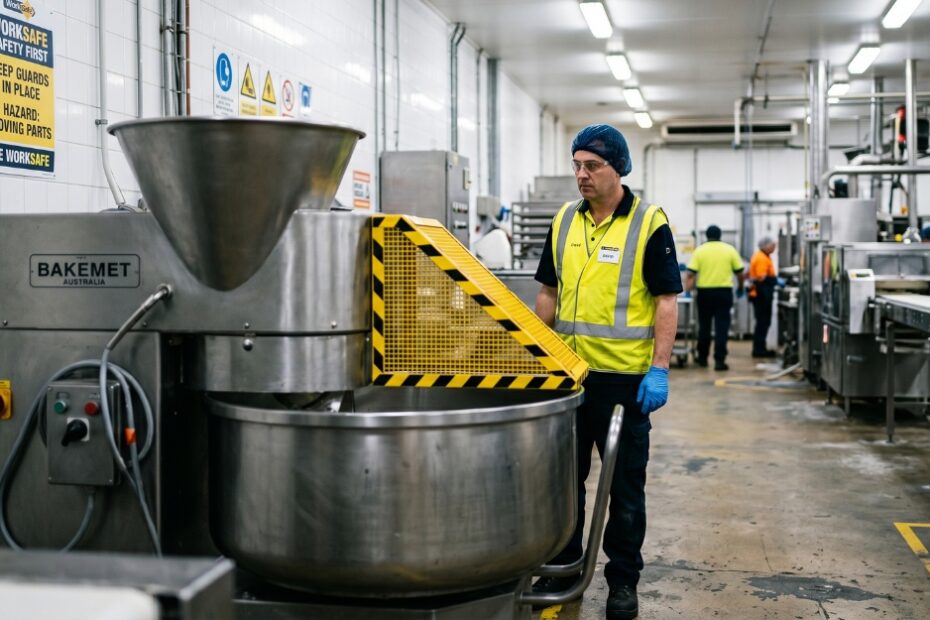
Makmur Enterprises Pty Ltd, a food manufacturing business (mainly known for its Dim Sims) supplying products to major supermarkets including Coles and Woolworths, was prosecuted following an incident involving an industrial dough mixer at its Richmond site in October 2024.
According to reports of the prosecution:
- A worker was operating a dough mixer with a rotating agitator blade
- The worker repeatedly reached into the bowl while the machine was operating
- A metal scraper bar was used to push dough back toward the centre
- The scraper was struck by the rotating blade
- The worker’s finger became trapped, causing a laceration injury requiring hospital treatment
WorkSafe alleged there was a clear risk of serious injury from workers accessing moving parts while the mixer was operating.
The Court was told it was reasonably practicable to install fixed and interlocked guarding to prevent access to the danger area during operation.
Makmur Enterprises pleaded guilty and was fined $180,000 plus costs.
However, A Vital Part Of This Case Was Not The Injury
It was the history.
The sentencing comments reportedly placed significant weight on the fact the company had faced multiple prior workplace safety prosecutions involving machinery and guarding risks over many years.
Once a business has already been warned through:
- previous incidents
- regulator interaction
- earlier prosecutions
- improvement notices
- industry alerts
- known hazard categories
…it becomes much harder to argue the risk was unforeseeable.
And that is where many organisations get exposed.
Not because they had no safety system.
But because the system did not actually stop the known risk from recurring.
The Commercial Lesson For Employers
This is where Operations, Safety, HR and Leadership teams need to work together.
A workplace incident is rarely viewed by regulators as:
“one worker made one mistake.”
Instead, the investigation often becomes:
- What was the system?
- Was the hazard identified?
- Was guarding appropriate?
- Was supervision adequate?
- Was unsafe behaviour tolerated?
- Were previous incidents analysed properly?
- Did leadership actually enforce the controls?
- Did the business learn from earlier warnings?
The above is a good snapshot for any decision maker.
Particularly in manufacturing, warehousing, logistics, construction and food production environments where repetitive tasks slowly become “normalised”.
Repetitive unsafe behaviour that becomes culturally accepted can eventually become “Exhibit A” in a prosecution.
Why This Matters Beyond Victoria
While this was a Victorian prosecution, the themes are national.
Employers in Queensland, New South Wales. South Australia and other states all around Australia are facing increasing scrutiny around:
- plant and equipment safety
- guarding
- systems of work
- psychosocial hazards
- supervision
- repeat incidents
- officer due diligence obligations
And importantly, regulators increasingly look at whether safety systems exist merely “on paper” or whether they genuinely operate in practice.
This distinction matters enormously when incidents occur.
One Of The Biggest Risks I See
Businesses often invest heavily after a serious injury.
But many fail to properly audit to eliminate or minimise risks and liability around:
- recurring risks
- legacy machinery
- bypassed controls
- workarounds staff have developed over time
- whether supervisors are enforcing the documented process
- whether production pressure is undermining safety systems
That gap between:
“the procedure says this”
and
“what actually happens on the floor”
is where prosecutions are frequently born.
After an incident, every shortcut, tolerated practice, missing control and ignored warning sign becomes visible very quickly.
And history matters.
Particularly if the regulator can show the business had already been warned.
Final Thoughts
This prosecution of $180,000 is another reminder that workplace safety is not just a compliance issue.
It is:
- operational risk
- leadership risk
- reputational risk
- legal risk
- and increasingly a governance issue.
The businesses best positioned are not the ones with the thickest safety manuals.
They are the ones consistently testing whether their systems actually work in practice.
If your organisation wants to proactively review:
- machinery and plant risk exposure
- psychosocial risk integration
- HR and WHS overlap issues
- investigation processes
- leadership obligations
- or practical workplace compliance systems
Our team regularly works with Employers, Safety and HR teams and leadership groups on practical workplace risk reviews and training across Australia.
👉 Read more about our training services at South Geldard Lawyers https://southgeldard.com.au/management-training/