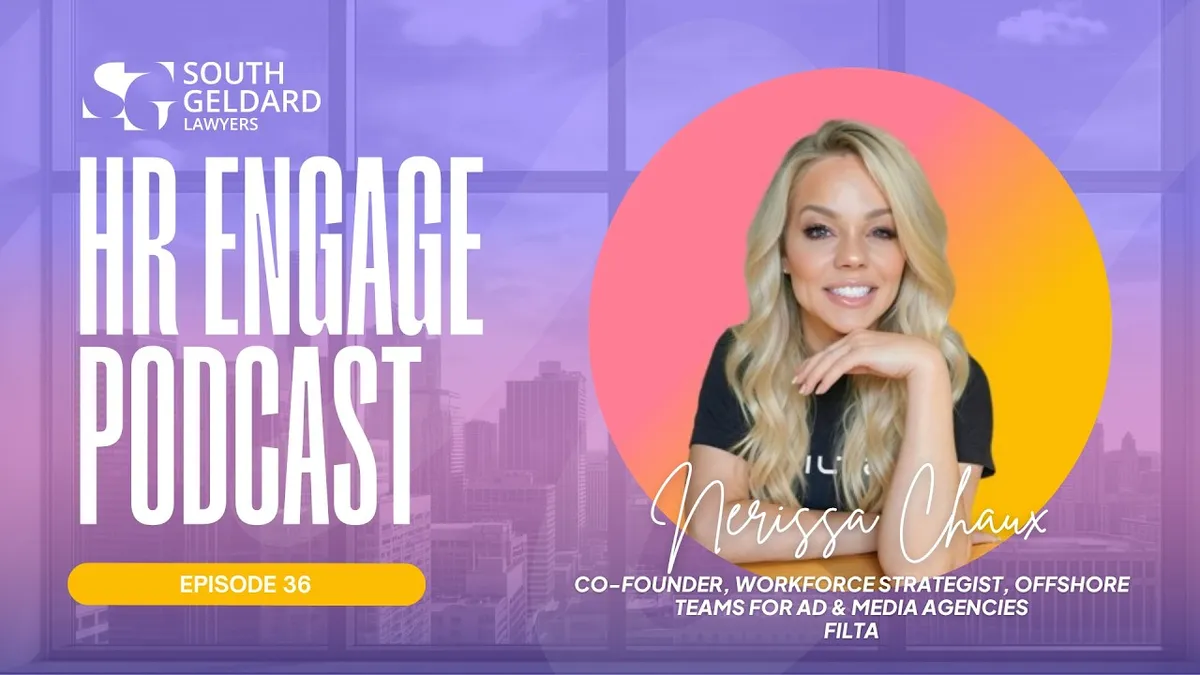
More Australian businesses are building teams overseas, and most of them run into the same problem: the work gets done, but the team never quite gels. In Episode 36 of the HR Engage Podcast, host Jonathan Mamaril, Director at South Geldard Lawyers, speaks with Nerissa Chaux, co-founder of Filta, a Brisbane-based business that builds offshore teams in the Philippines and Colombia for clients in Australia, New Zealand, the UK, the US and Canada.
Nerissa's path into HR is unusual. She studied theology and worked as a Christian minister before moving into recruitment, co-founding a recruitment business during the GFC, selling it in 2016 and launching Filta in 2017. Her view of work is direct, commercial and people-focused at the same time, and it makes for a practical conversation about offshore teams, return to office and what it takes for HR to be valued.
Key points
- Offshore teams usually struggle because of communication, not capability. Cultural intelligence is the missing piece.
- Simple habits work: cameras on, a 15-minute daily check-in, intentional one-on-ones and including offshore staff in company meetings.
- Make return to office decisions role by role, be honest about the real reason, and expect some staff hired as remote workers to leave.
- HR earns a seat at the table by linking people decisions to commercial outcomes and a measurable return.
Why offshore teams fail: cultural intelligence
Nerissa's central argument is that cost savings are the obvious part of outsourcing and offshoring. What nobody teaches, she says, is how to understand another culture, how to engage with people from it, and how to get a real return on the investment.
She calls this missing piece cultural intelligence. Australians, New Zealanders, Americans, Filipinos and Colombians all communicate differently, and assuming they are the same is where problems start. When international teams struggle, the root cause is usually communication: something said one way is heard another way, and nobody is in a position to translate intent.
That is why Filta makes a two-hour cultural intelligence workshop mandatory for every new client. The sessions are practical and interactive rather than slides and videos. Nerissa shared the example of a New Zealand client whose local team had stopped trusting its Filipino team. Two managers who had skipped the training completed it, applied the advice, and the client reported a 40% improvement in outcomes within a week.
How to keep your culture with an offshore or remote team
Jonathan asked how businesses keep the culture and values they have built locally when part of the team sits overseas. Nerissa's answer is that it starts at recruitment and depends on being intentional, because nothing happens by accident when people are not in the same room.
Her practical checklist for managing remote and offshore teams:
- Hire people you would want to sit next to. When you recruit over Zoom, ask whether working with that person every day would energise you or drain you.
- Turn cameras on. People connect through faces and body language. Cameras let you see whether someone is listening, understanding or lost.
- Hold a 15-minute daily check-in. How are you, what is your focus today, any roadblocks? It builds relationships and buy-in, and it is where most managers fall down.
- Make one-on-ones intentional. Weekly or monthly, ask what is working, what is not, and what each side needs to change. Do not let issues slide.
- Include offshore staff in company-wide meetings. Strategy days and quarterly updates keep everyone connected to the vision. If the local team is eating lunch, send the offshore team lunch too.
None of this is complicated. Nerissa's point is that the basics work, and that managers who say they have no time for 15 minutes a day see the difference once it becomes a habit.
The role of HR in managing international teams
According to Nerissa, HR teams are often most worried about employment law in other countries: probation, performance management and pay. With an outsourcing partner, much of that is handled on the ground, so HR's focus shifts to integration. How do we treat international staff the same way? How do we make sure our values are present and active offshore?
Practical alignment matters here. Nerissa gave the example of annual salary reviews, where HR, the outsourcing partner and finance agree budgets and salary bands for each country before line managers have any conversations, so everyone is on the same page.
For Australian employers, it is worth remembering that employment law obligations differ between countries and depend on how the arrangement is structured. Our employment lawyers can help Australian businesses understand their obligations to their local workforce as they grow.
Return to office: be clear on the real reason
The second big theme is the return to office debate. Nerissa sees more clients asking teams to come in two or three days a week, and strong pushback from staff who were hired when work was fully remote.
Her view is nuanced. She does not accept that office work is automatically more productive, because many remote workers hit every target. For Filta, the case for time in the office is about connection, mental health and learning. Around 17% of its workforce is Gen Z, and many younger staff had little face-to-face experience of school or work. They told Filta they were nervous about office etiquette and presenting, but felt more confident and connected once they were learning from colleagues in real time.
Her advice to employers considering a return to office mandate:
- Decide role by role rather than imposing one rule on everyone.
- Be honest about your real motivation. If productivity is not actually the problem, do not use it as the reason.
- Be prepared for resignations. People hired as remote workers may leave for roles that offer flexibility, so weigh that commercially before you decide.
Jonathan noted that return to office decisions also sit within a legal framework, with regulation, recent cases and differences between states all playing a part. Employers should check their obligations before changing work arrangements. Our guide to flexible work arrangements and reasonable business grounds is a useful starting point.
HR needs to understand the commercial reality
Nerissa's advice for senior HR professionals is blunt: the biggest gap she sees is a lack of commercial understanding. HR needs two hats, an empathetic people hat and a commercial reality hat. She has seen businesses delay hard decisions such as redundancies out of concern for morale until the business itself was at risk, and an HR manager recommend a 10% pay rise for an employee who was on a performance improvement plan.
Her answer to Jonathan's signature question, what people might disagree with her about, follows the same thread. HR professionals need to show how their work drives the business forward, whether through retention, hiring for new divisions or learning and development that delivers a measurable return. Every initiative, from a conference to a new quarterly review process, should be backed by a commercial case and, ideally, data. That, she says, is how HR earns a seat at the table.
Career advice for HR professionals
For early-career HR, Nerissa's advice is to:
- Be curious. Ask questions and take an interest in people. That is when you learn the most.
- Do what scares you. If you avoid recruitment, learning and development or public speaking, that is usually a confidence gap worth closing.
- Get comfortable with hard conversations. Most people leave them too late. Learn from someone more senior, or seek advice from HR networks if there is no one internally.
Her parting message: be brave, say yes to opportunities and challenge yourself, even when it feels uncomfortable.
Frequently asked questions
In this episode, Nerissa Chaux describes cultural intelligence as understanding how people from different countries communicate, interpret information and solve problems. She says it is the piece most often missing when offshore and outsourced teams fail.
Nerissa's advice is to be intentional from recruitment onward: hire people you would want to work alongside, keep cameras on, hold short daily check-ins, run regular one-on-ones and include offshore staff in company-wide meetings and events.
Nerissa recommends deciding role by role, being honest about the real reason for the change, and weighing the risk that staff hired as remote workers may resign. Employers should also check their legal obligations, including flexible work rights, before changing work arrangements.
Key takeaways for employers
- Offshore and remote teams succeed or fail on communication, so invest in cultural intelligence, not just cost savings.
- Simple, consistent habits (cameras on, daily check-ins, inclusion in company meetings) do more than complex programs.
- Make return to office decisions role by role, know your real reason and check your legal obligations first.
- HR is valued when it links people decisions to commercial outcomes.
If your business is changing work arrangements, restructuring or managing performance issues, contact our employment law team for advice. You can find more episodes of the HR Engage Podcast on our podcasts page, on Spotify and Apple Podcasts, and on the HR Engage YouTube channel.
This article is general information about the law as it applies in Queensland, current at the date of publication. It is not legal advice and does not take your circumstances into account. The law changes. Speak to one of our lawyers before acting.
Filed under HR Engage Podcast, HR Engage Video, Employment